

The Fast We Choose
by Fr. Chris McPeak, Rector
Dear Good Samaritans,
It is hard to believe that in six days we will enter the season of Lent.
 Last week in the Across the Diocese Newsletter our Bishop, Phil, invited the Diocese into a shared Lenten fast. In that letter he reminded us of Dietrich Bonhoeffer’s warning that the crises of his time were not merely political or economic, but spiritual. The Church, he feared, might fail to recognize the real issue. We must ask ourselves that same question now.
When Scripture speaks of communities facing overwhelming evil, one of the faithful responses we see again and again is fasting. As The Rev. Dr. Samuel Torvend (one of my very favorite priests in this diocese and also, in my opinion, absolutely brilliant) writes, fasting “occurs when individuals are afflicted by overwhelming evil,” and it “serves as a communal sign of protest in the presence of social disasters.” For Jesus, fasting “is a prayer for the advent of God’s kingdom, God’s just and peaceful reign in human life, communities, and in the creation itself.”
Fasting, then, despite the disproportionate concern in life and movies, is not mainly about chocolate.
It is about resistance and solidarity.
Former Archbishop of Canterbury Rowan Williams once described fasting not simply as giving up material things, but as “denying yourself the pleasures of thinking of yourself as an isolated being with no real relations with those around; denying yourself the fantasy that you can organize the world to suit yourself; denying yourself the luxury of not noticing the suffering of your neighbor.” This, he said, is “fasting that reconnects you with reality.”
In a culture of relentless consumption, curated outrage, and convenient denial, fasting becomes a way of stepping back into God’s reality. It is resistance to indifference. It is solidarity with those whose suffering is easy for us to overlook. It is a way of allowing the Spirit to clear away our self-satisfaction and bind us more deeply to one another.
The Christian tradition has long understood fasting as having two aspects: physical and spiritual. Physical fasting involves abstinence from foods. Spiritual fasting consists in abstaining from evil thoughts, desires, and deeds. The purpose is not punishment but freedom. We gain mastery over ourselves so that we are not ruled by appetite, anger, or fear. It is liberation from dependence on the things of this world in order to concentrate on the things of the empire of God.
This Lent, I will be fasting daily—except for Sundays, which are always feast days! I will eat breakfast and then nothing until dinner with no snacking. I intend to eat more simply in the evenings, freeing time and mental energy for prayer, for my family, and for the work God has given me. On Ash Wednesday and Fridays, I will abstain from meat—not because there is anything wrong with meat (I do love bacon)—but as a reminder that many do not have that luxury, and that our food systems, when driven only by efficiency and profit, can damage both animals and the earth.
Sundays will remain celebratory—a weekly reminder that resurrection joy interrupts everything, even our disciplines.
I share this not to draw attention to myself, but to invite you into your own intentional practice so that, as a community, we can share a fast with our larger church.
Your fast may look very different. And I want to be very clear here: fasting from food is not safe or wise for everyone. Those living with certain medical conditions, those who are pregnant or nursing, those with a history of eating disorders, and those whose work or caregiving responsibilities require steady energy and mental clarity—those who cannot afford to be “hangry” or even experience a moment of diminished focus—should think very carefully about how and if a food fast is appropriate. If that is you, please know this: you are not less faithful. God does not require your blood sugar to drop in order to love you. And, there are still ways to join in.
While some may adopt a similar rhythm of food fasting, others may fast from social media, unnecessary purchases, constant news, cynicism, or harsh speech.
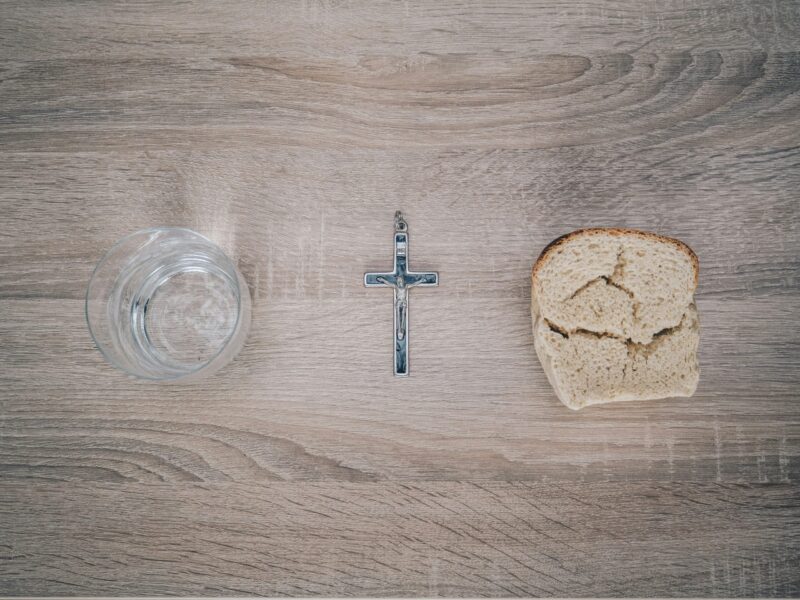
If a food fast is still important, maybe other approaches could be helpful. Maybe fewer sweets or processed foods. Or, take more time to appreciate simple food and drink like water and good bread.
But there are also many, many other ways to fast, many that are embodied that aren’t food. Thanks to the book The Art of Fasting by Thomas Ryan for these ideas:
- Fast with your eyes: watch less TV, videos, news, etc. and reflect more on your life and start keeping a journal.
- Fast with your ears: turn down the music or podcasts, pay attention to your inner thoughts and desires and listen more attentively to others.
- Fast with your feet: become attuned to the modern compulsion to be always on the go—resist that, rest, meditate, or go for a walk without a purpose other than wandering.
If you begin any practice and find it is not life-giving and faith-deepening, stop. Try something else. Lent is not a test of endurance. It is a season of truth and mercy. Because, at the end of the day, the deeper question of Lent is this: What, if loosened, would make more room for God? What would reconnect you with reality? What would sharpen your compassion and deepen your solidarity with those who suffer?
Our world hungers for a Church that sees clearly, resists dehumanization, and lives as a community of mutual generosity and care. May our fasting this year be a communal sign of protest, an act of solidarity, and above all a prayer for the advent of Christ’s just and peaceful reign.
Blessings,

NEWS & MESSAGES
Some Thoughts on Pain, 7/5/2023
Some Thoughts on Pain by Charissa Bradstreet, Interim Rector I recently listened to a podcast that
Rector Search Committee Update – 07/03/2023
Rector Search Committee Update - 7/3/2023 by Carol Stamper, Rector Search Committee Chair Candidates Received! Dear Fellow
The Nativity of John the Baptist – 06/21/23
The Nativity of John the Baptist and the Tender Mercy of our God by Charissa Bradstreet, Interim Rector
Why I Participate in Pride Month — 06/06/2023
Why I Participate in Pride Month by Charissa Bradstreet, Interim Rector On June 25 the Diocese of
3 Habits to Support Reconciliation 4/18/2023
3 Habits to Support Reconciliation by Charissa Bradstreet, Interim Rector This past Sunday we started our new
Rector Search Committee Update – 04/11/2023
Rector Search Committee Update - 4/11/2023 by Carol Stamper, Rector Search Committee Chair Rector Search Committee
Blessed are Those Who Feel Alone
Blessed are Those Who Feel Alone by Charissa Bradstreet, Interim Rector That is the theme this
Blessed are We, the Hungry
Blessed are We, the Hungry by Charissa Bradstreet, Interim Rector That is a line from the
40 Days to Reflect, Pray & Bless our Imperfect Lives
The Lives We Actually Have: 40 Days to Reflect, Pray & Bless our Imperfect Lives by Charissa Bradstreet, Interim
Pancakes and Penance
Pancakes and Penance by Charissa Bradstreet, Interim Rector
A Message from the Rector – 02/02/23
Incarnation by Mthr. Charissa Bradstreet, Interim Rector What difference does it make that Jesus was incarnate?
Results from Parish Survey – A Message from the Vestry – 01/19/2023
Results from Parish Survey by the Profile Committee If you missed the presentation of the results